Two quotations arrive for the same 3 m power cord, or the same Cat6 patch lead, and the prices differ by a third. The copper, the gauge and the connector are the same. The difference is four letters on the datasheet: PVC on one, LSZH on the other. Buyers who treat the jacket as a cosmetic upgrade either overpay for a material the project never needed, or — far worse — ship cable that fails the reaction-to-fire class the building inspector asks for. This guide explains what the two materials genuinely do differently, which standards turn those differences into pass/fail numbers, how the European CPR classes work in practice, and how to write a jacket requirement that a factory cannot quietly substitute.
What the jacket is actually doing
The jacket, or sheath, is the outermost polymer layer. It is not the insulation: insulation sits directly on the conductor and is chosen for dielectric loss and thermal endurance, while the jacket is chosen for mechanical survival and fire behaviour. Confusing the two is the root of a large share of specification errors, because a cable can have polyethylene insulation with excellent electrical properties and still be wrapped in a PVC jacket that produces dense smoke.
- Mechanical protection. Abrasion during pulling, crush resistance in trays, cut-through at cable ties, flex life in moving applications.
- Environmental protection. Water absorption, oil and fuel contact, UV exposure, rodent and termite attack, chemical splash.
- Fire behaviour. Whether the material ignites, how fast flame travels along it, how much heat it releases, how much smoke it makes, and whether that smoke is acidic and conductive.
The last group is where PVC and LSZH separate, and it is the only group that is regulated. Everything else is a datasheet negotiation.
The four jacket materials you will be quoted
PVC — polyvinyl chloride
PVC is a chlorine-based polymer and the default jacket for volume cable. The chlorine content makes it inherently flame retardant without heavy filler loading, which is why PVC compounds are cheap, smooth, flexible and easy to extrude at high line speed. It has good wear resistance and resists most dilute chemicals.
The same chemistry is the problem. When PVC burns it releases hydrogen chloride and other acidic gases, and it produces dense black smoke that obscures escape routes. In a fire the hazard is rarely the flame front; it is the loss of visibility and the corrosive gas attacking electronics, switchgear and ventilation. PVC remains the correct choice for enormous volumes of product — generic indoor wiring, in-box cables, patch leads in dry offices — but it is the wrong choice wherever people evacuate through the space or where sensitive equipment sits in the same compartment.
LSZH — low smoke zero halogen
LSZH compounds are halogen-free formulations, normally a polyolefin base loaded with mineral fillers such as aluminium hydroxide or magnesium hydroxide. The filler releases water vapour endothermically when heated, which cools the polymer and dilutes combustible gases; because there is no chlorine or bromine in the chain, the combustion products are far less acidic.
The trade-offs are physical. Mineral fillers make the compound stiffer and rougher than PVC, reduce wear resistance, and complicate extrusion, all of which raises cost. LSZH cable is harder to pull in cold weather and less tolerant of tight bend radii, so installation crews notice the difference before the customer does. Those are engineering facts to design around, not reasons to avoid the material: in tunnels, metro systems, hospitals, airports, schools, data halls and any space with a defined evacuation strategy, LSZH is usually the only jacket that satisfies the fire specification.
PE and HDPE — the outdoor default
Polyethylene has excellent dielectric properties, very low water absorption and good weather resistance, which is why it dominates outdoor, duct and aerial constructions. It is not inherently flame retardant, so a plain PE jacket is a poor choice indoors. Where an outdoor cable must enter a building, the usual answer is a dual jacket or a transition to an LSZH-sheathed indoor length at the entry point.
PUR — polyurethane, for movement and oil
Polyurethane jackets are chosen for mechanical aggression rather than fire performance: drag chains, robotic arms, machine tools, port equipment, welding cells. PUR resists abrasion and oil far better than PVC or LSZH and stays flexible at low temperature, at a higher material cost. A PUR cable still needs a defined fire performance if it runs indoors, and that performance comes from the compound formulation, not from the letters PUR.
| Property | PVC | LSZH | PE / HDPE | PUR |
|---|---|---|---|---|
| Halogen content | Chlorine-based polymer | Halogen-free compound | Halogen-free | Halogen-free |
| Smoke in fire | Dense, dark | Low | Moderate to high | Moderate |
| Acid gas | High (HCl) | Low | Low | Low |
| Flame retardancy | Inherent | Compound dependent | None by itself | Compound dependent |
| Abrasion / flex | Good | Fair | Fair | Excellent |
| Oil resistance | Fair | Fair | Poor | Excellent |
| Relative material cost | Lowest | Higher | Low | Highest |
| Typical use | Indoor power, patch cords, in-box cable | Public buildings, tunnels, hospitals, data halls | Outdoor, duct, aerial | Robotics, drag chain, machine tools |
Table 1 — jacket materials compared. “Compound dependent” is not a hedge: two LSZH compounds from two suppliers can sit in different CPR classes, which is why the declaration matters more than the material name.
The tests that turn “LSZH” into a number
A supplier can print LSZH on any jacket. What cannot be printed without a test report is a class. The European suite uses four measurements, and each answers a different question.
EN 60332-1-2 — single insulated wire in a 1 kW flame
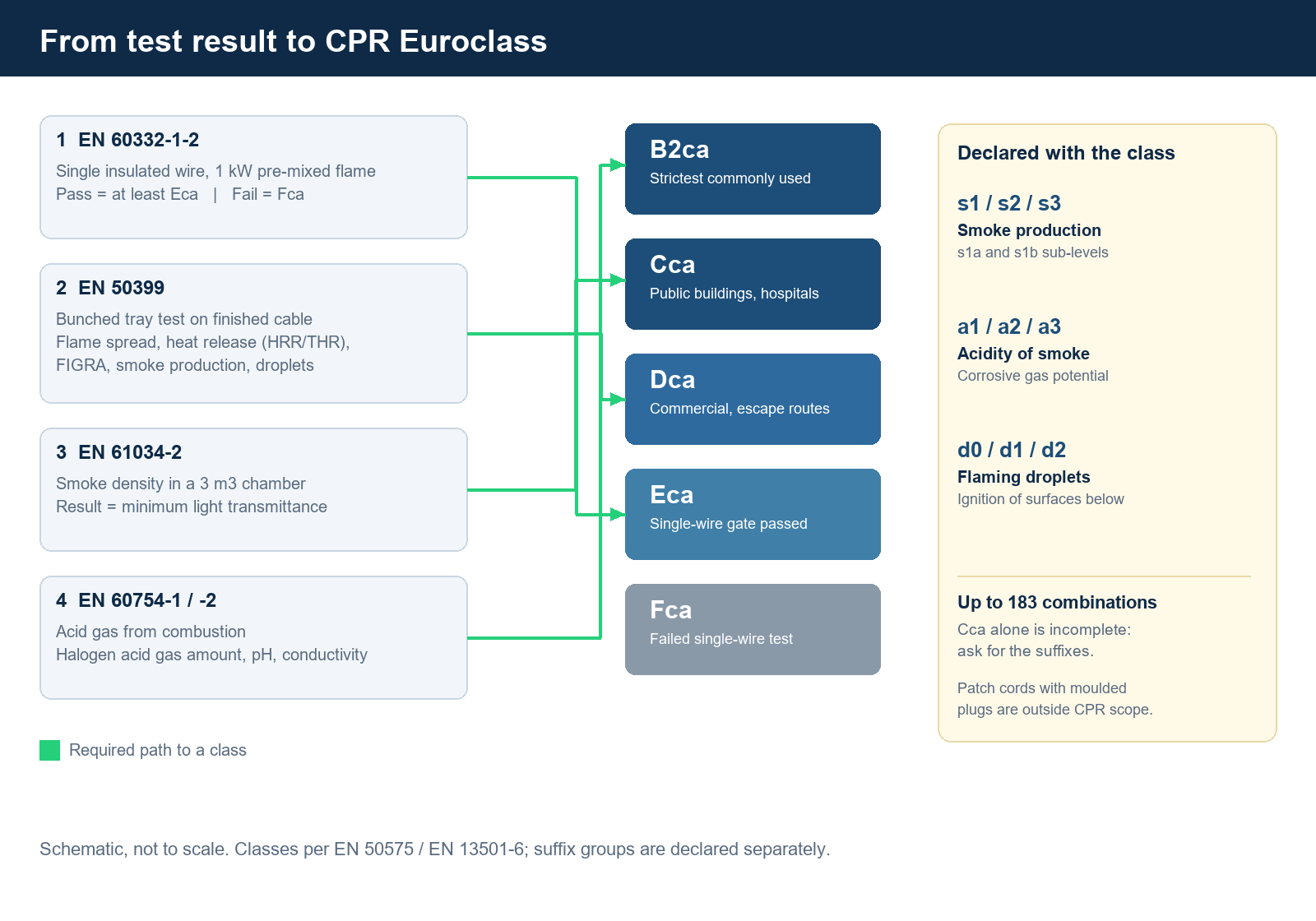
One cable is held vertically and exposed to a 1 kW pre-mixed flame for a defined time; the test measures how far the char travels above the point of application and whether burning droplets ignite the base. It is the entry gate of the whole system: in the CPR framework a construction that passes this test can be declared at least Eca, and a construction that fails falls to Fca. No amount of marketing survives that result.
EN 60332-3-24 — the bunched test
Real trays are not single cables. The bunched test burns a ladder of cables in a vertical tray and assesses how far the fire propagates through the bundle. A compound that passes the single-wire test comfortably can still fail in a bundle, because the neighbouring cables preheat each other and the fire loads add up. This is the test that separates a genuine flame-retardant compound from one that merely survives a laboratory wire.
EN 60754-1 and EN 60754-2 — acid gas
Part 1 determines the amount of halogen acid gas released during combustion; part 2 determines the acidity of the evolved gases as pH and conductivity. These two numbers are what “zero halogen” actually means in a laboratory, and they are the reason LSZH exists: corrosive condensate destroys switchgear, control electronics and ventilation long after the fire is out. A practical screen used in the industry is an X-ray fluorescence check on the compound, with halogen content below 0.2 % by weight treated as halogen-free.
EN 61034-2 — smoke density
A defined cable sample burns inside a 3 m³ chamber and a light beam measures the minimum transmittance through the smoke. This is the measurement behind the “low smoke” claim, and it is the one that matters most for evacuation: people do not need a flame front to die, they need visibility to disappear. A PVC jacket and an LSZH jacket can both be flame retardant and still differ enormously here.
CPR Euroclasses: the language that travels
Inside the European Union the reaction-to-fire performance of permanently installed cables is declared under the Construction Products Regulation through the harmonised standard EN 50575, first published in 2014 and amended in 2016, with classification carried out to EN 13501-6. The result is a Euroclass, and there are seven of them: Aca, B1ca, B2ca, Cca, Dca, Eca, Fca. In practice four are commonly used — B2ca, Cca, Dca and Eca.
The class is only half of the designation. Three suffix groups describe what the smoke does:
- s1, s2, s3 — smoke production, with s1 further split into s1a and s1b; five levels in total.
- a1, a2, a3 — acidity of the smoke effluents.
- d0, d1, d2 — flaming droplets and particles.
Combining the main class with the three suffix groups produces up to 183 possible combinations. Individual member states then decide which combinations they require for which building type, which is why a cable declared Cca-s1,d1,a1 can be acceptable in one country and insufficient in another. A quotation that says only “Cca” is incomplete; the suffixes are part of the declared performance.
| Euroclass | What has to be passed | Where it is typically specified | AVCP system |
|---|---|---|---|
| Eca | EN 60332-1-2 single-wire flame test | General indoor runs, low-risk areas | 3 |
| Dca | Single-wire test plus limited bundle performance | Commercial buildings, escape routes | 3 |
| Cca | Single-wire plus EN 50399 bundle test, heat and smoke limits | Public buildings, hospitals, schools | 1+ |
| B2ca | Strictest commonly used bundle performance, with s1/d1/a1 suffixes | Tunnels, metro, airports, high-occupancy spaces | 1+ |
| Fca | Failed the single-wire test | Not acceptable for permanent installation in most markets | 4 |
Table 2 — the Euroclass ladder as defined through EN 50575 and EN 13501-6. AVCP is the assessment and verification system: 1+ requires notified-body surveillance of factory production control, 3 requires initial type testing, 4 relies on the manufacturer’s declaration alone.
Two scope traps inside the CPR
First, the regulation covers cable intended for permanent installation in construction works. A patch cord with connectors moulded on both ends is outside its scope, which means an LSZH patch cord is a voluntary product decision, not a declared class — useful to know when a customer asks for a “CPR certificate” on a 2 m lead. Second, as of the current published framework, fire-resistant cable performance is not yet classified under the CPR; member states still apply national rules, so a project that needs circuit integrity must be specified against the local standard rather than a Euroclass alone.
The naming trap: five labels, one material, no legal definition
The market writes LSZH, LSOH, LSHF, LSF and “halogen-free” on datasheets, and they all describe roughly the same intention. None of those strings is a class. Three specific misunderstandings cost buyers money:
- Halogen-free is not the same as flame retardant. A halogen-free compound can be made from a polyolefin with no fire package at all. Halogen-free answers the acid-gas question and says nothing about flame spread.
- “FR” on a PVC jacket is still PVC. Flame-retardant PVC reduces flame spread; it does not remove chlorine, and it does not make the smoke light.
- European and North American languages do not translate. Plenum and riser ratings under UL 910 / NFPA 262 and UL 1666 describe smoke and flame performance in a specific North American test setup; Cca or B2ca describes a European one. A cable can carry one and not the other. Ask for the test report that matches the market you are selling into.
Which jacket for which product family
Power cords and power supply cords
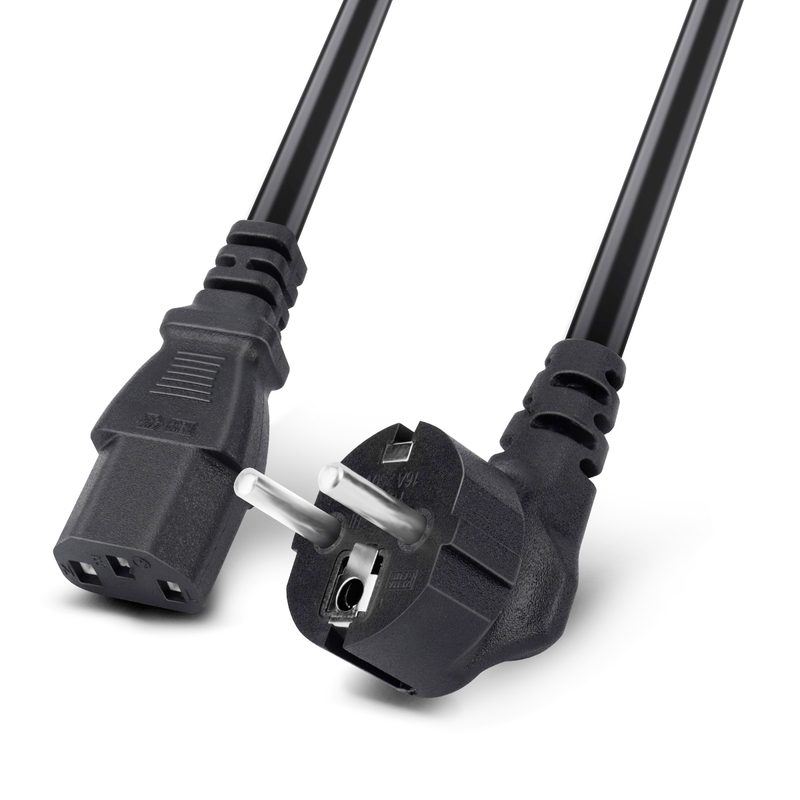
Harmonised power cords are where PVC still dominates, because the jacket has to be flexible, resist abrasion on a factory floor and survive being coiled thousands of times. The harmonised H05VV-F family is the familiar PVC construction; the halogen-free equivalent is designated in the H05Z1Z1-F family, where the Z code marks a thermoplastic halogen-free compound. When a European tender specifies halogen-free cords, the safe specification is the harmonised designation plus the CPR class and suffixes, not the word LSZH. Our power cord range is produced in both PVC and halogen-free versions with EU, UK, US and AU plugs, and every order can carry the compound and class on the inspection record.
Network and patch cables
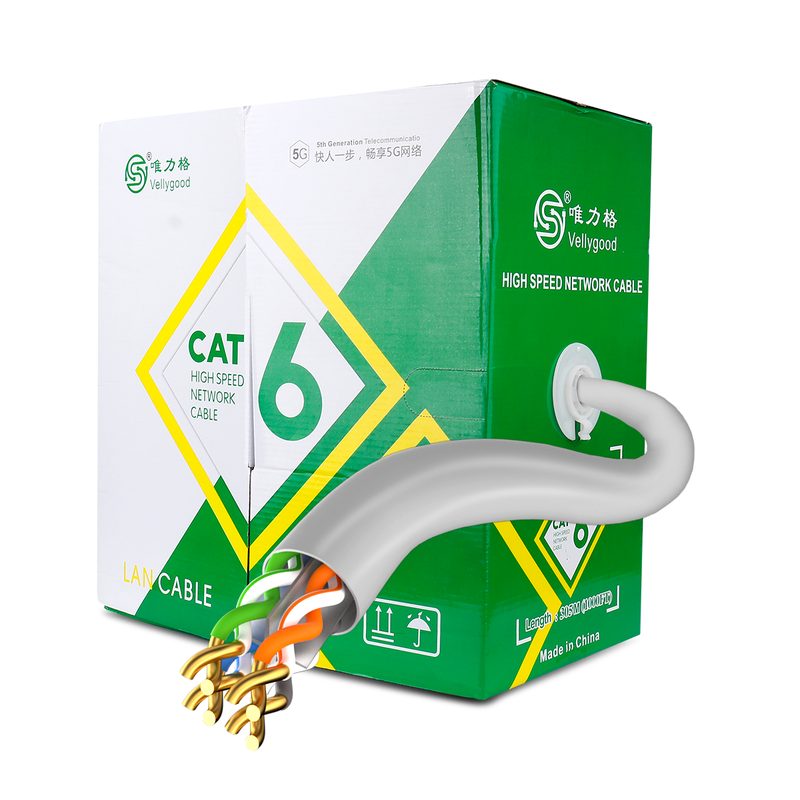
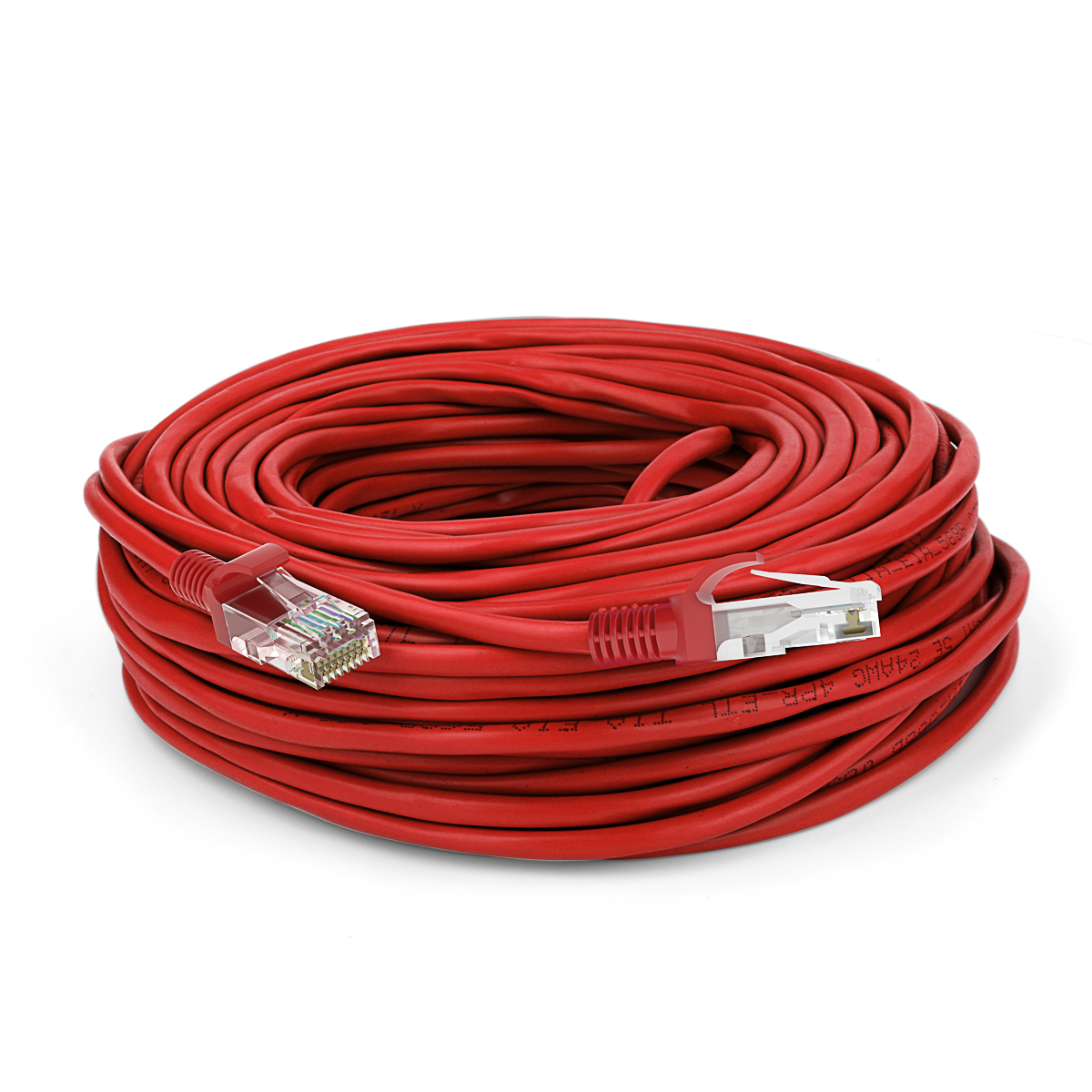
In LAN cable, the jacket decision follows the pathway. Open office ceiling voids and dry risers are usually fine with PVC; hospitals, schools, data halls and any space with a defined evacuation strategy move to LSZH. In North America the equivalent decision is expressed as riser or plenum rating rather than as a material. Note that a Cat6 patch cord with moulded plugs is outside the CPR scope, while the same cable supplied on a reel for permanent installation is inside it — so the same compound can need two different sets of paperwork. Our network cable range covers Cat5e to Cat7 in PVC and LSZH, in bulk reels and patch cords.
HDMI, DisplayPort and AV assemblies
Consumer in-box cable is almost always PVC, and that is a rational cost decision. The moment the same assembly goes into a hotel, a classroom, a stadium or a cruise ship, the jacket becomes part of the fire strategy, and LSZH jackets are specified for the same reason as in LAN cable. The electrical performance does not change; the compound does. Our HDMI cable range is available in both finishes.
Industrial and moving applications
Where the cable flexes continuously or sits in oil mist, PUR is usually the only jacket that survives the duty cycle, and the fire requirement is met by the compound rather than by the base polymer. A jacket that fails mechanically in month three is not improved by an excellent fire class.
Five mistakes and what they cost
- Accepting “LSZH” without a class. The goods arrive halogen-free but without a bundle test, the project asks for Cca, and the re-test is on your account.
- Specifying a class without suffixes. Cca-s1,d1,a1 and Cca-s3,d2,a3 are both “Cca”; the difference is exactly the smoke and droplets performance the specifier cared about.
- Assuming a patch cord carries a CPR declaration. Connectorised leads are outside the scope; the request cannot be met with a certificate that does not exist.
- Substituting PVC for LSZH to hit a price. The jacket looks identical and the cable passes a continuity test, so the substitution is only discovered in a fire test, an insurance review or a failed site inspection.
- Buying LSZH for a moving application. The cable meets the fire class and fails mechanically, because wear resistance was never part of the comparison.
Procurement checklist
- Name the base material and the required class, for example “LSZH compound, Cca-s1,d1,a1 to EN 50575”.
- State the standard for each claim: EN 60332-1-2 for single wire, EN 60332-3-24 for bunched, EN 60754-1/-2 for acid gas, EN 61034-2 for smoke.
- For North American projects, state the UL or NFPA rating instead — do not translate one system into the other.
- Ask for the declaration of performance and the test report, not a logo.
- Confirm whether the item is permanently installed cable or a connectorised assembly, because the scope differs.
- Write the rated temperature and the bend radius on the order; a stiffer LSZH compound changes both.
- Keep the jacket compound as its own line item so that a substitution becomes a documented change, not an assumption.
- Ask for a retained sample and the compound supplier’s data sheet with the first shipment.
- For moving applications, specify the flex duty cycle and the oil exposure before discussing fire class.
- Decide who pays for the re-test if the delivered compound lands in a lower class than declared.
FAQ
Is LSZH cable more expensive than PVC?
Yes, at the compound level. The fillers, the lower extrusion speed and the tighter process window all add cost, and the gap widens as the required class rises. The correct comparison is not price per metre but price per compliant metre, because a PVC cable that cannot be installed on the project has no value at all.
Does LSZH mean the cable will not burn?
No. LSZH describes what the smoke contains and how much of it there is. Flame spread is a separate measurement: a halogen-free compound with a weak fire package can fail the single-wire test and be declared Fca.
Can a PVC cable be low smoke?
Smoke can be reduced with additives, but the chlorine is still in the polymer, so the acid-gas performance does not become halogen-free. If the specification asks for low smoke and low acidity, the jacket has to change material.
Is Cca better than B2ca?
B2ca is the higher performance class and is the one normally required in tunnels, metro and high-occupancy buildings. Cca is a mid-range class widely used in public buildings. “Better” only matters against the requirement in the project specification and the national rules that apply to the building type.
Why does the same LSZH compound appear in different classes?
Because the class is a property of the finished construction, not of the compound alone. Conductor size, insulation thickness, jacket thickness, fillers and the way the cable burns as a bundle all affect the result, which is why the declaration is made per construction.
Conclusion
PVC and LSZH are not good and bad versions of the same product. They are two engineering answers to two different questions: cost and mechanical toughness on one side, smoke, acidity and evacuation safety on the other. The mistake is to decide between them on price. Decide on the fire strategy of the building, then write the material, the test standard and the class with its suffixes onto the purchase order, then ask for the declaration that proves it. Buyers who do that stop discovering the jacket decision in a failed inspection, and start getting the cable they actually specified.
Sources
Nexans, “Q&A CPR” (fire safety FAQ, retrieved 2026-10) — EN 50575:2014 + A1:2016, EN 13501-6 classification, the seven Euroclasses Aca to Fca, EN 60332-1-2 as the entry gate to Eca with Fca on failure, EN 50399 bundle parameters (FS, HRR, THR, FIGRA, TSP, SPR), EN 61034-2 smoke density, EN 60754-2 pH and conductivity, suffix groups s1–s3 / a1–a3 / d0–d2 and the 183 possible combinations, AVCP systems 1+ / 3 / 4, patch cords with connectors outside CPR scope, fire-resistant cables not yet classified. Fiber-Life, “Choosing Between LSZH and PVC Cable Jackets” (23 December 2024) — halogen content below 0.2 % by weight as the halogen-free screen, LSZH stiffer and rougher with lower wear resistance, PVC smoother and more flexible, UL 1581 / UL 1666 / UL 910 references for PVC. Gcabling, “Cable Jacket Material: How to Choose” (6 June 2024) — PVC smoke and toxic gas behaviour, PE weather and moisture resistance, selection factors. Material and cost comparisons in Table 1 are qualitative; exact compound properties vary by supplier and must be confirmed against the supplied data sheet and test report.