
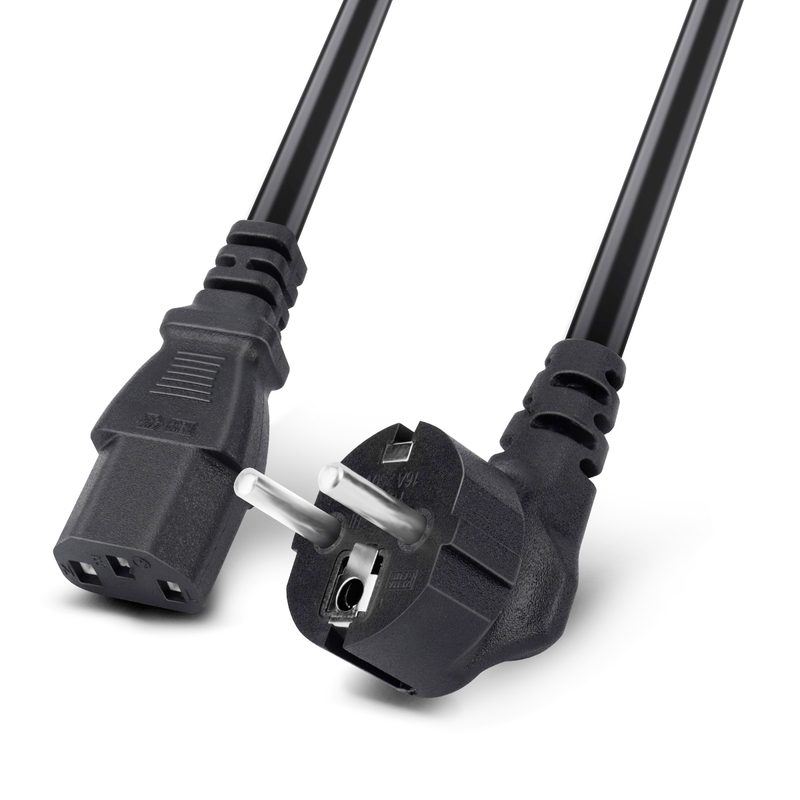
A purchasing manager in Rotterdam approves a specification for “16 AWG, 3-core, PVC”. The samples arrive, the jacket print matches, the plugs fit, and the first container is paid for. Eight months later the field returns start: the cords run warm on a 10 A appliance and a few of them have failed at the strain relief. The conductor inside those cords measures 0.52 mm². Sixteen AWG is 1.31 mm². Nobody lied about a number that can be printed; the number itself was a diameter scale from a country the buyer was not buying in, and it had been translated into a metric figure by a quotation clerk. This is the characteristic failure of gauge specification, and it is worth understanding because gauge is the one line on a cable drawing that decides cost, temperature and whether the product can be sold.
This guide covers what AWG actually defines, how it converts to mm² and why the conversion never lands on a round number, how conductor class changes the answer at the same nominal size, what ampacity really depends on, and the wording that stops a substitution before it reaches a container.
What AWG defines, and the three things it does not
American Wire Gauge is a logarithmic, stepped standard for the diameters of round, solid, nonferrous, electrically conducting wire, in use since 1857 and defined today by ASTM B258. The definition is geometric rather than electrical: 36 AWG is exactly 0.005 inch (0.127 mm) in diameter, 4/0 AWG is 0.46 inch, and the ratio between those two is 92 across 39 steps. Every successive gauge is therefore the 39th root of 92 apart, a factor of about 1.1229 in diameter, which means each step adds roughly 26% to the cross-section.
The formula the standard fixes is dn = 0.127 mm × 92(36−n)/39, where n is the gauge number for sizes from 36 down to 0, and negative values are used for 00, 000 and 0000. Two consequences matter commercially. First, the series is a geometric progression, so the gaps are not equal in millimetres: the difference between 24 and 22 AWG is 0.13 mm, and the difference between 12 and 10 AWG is 0.54 mm. Second, the area, which is what carries current, grows with the square of that diameter, so the gauge number is a poor mental model for capacity. Buyers who think in “two sizes thicker” are thinking in diameter; what they are buying is area.
Three limits are worth stating explicitly, because all three are exploited in the market. AWG describes a solid, round conductor: a stranded conductor is given the AWG of the equivalent solid area, not of its outside diameter, and because round strands leave gaps of about a quarter of the bundle, a stranded wire of the same gauge measures roughly 13% larger across. AWG describes nonferrous metal: it says nothing about which metal, so an aluminium conductor and a copper conductor can carry the same gauge number and behave completely differently. And AWG is a diameter standard, not a current rating: no part of ASTM B258 tells anyone how many amperes the wire may carry.
The arithmetic a buyer can do in their head
Three rules of thumb from the geometry cover almost every commercial conversation. Three steps of gauge number roughly doubles the area and therefore halves the resistance, because 926/39 is very close to 2. Six steps doubles the diameter and quadruples the area. Ten steps multiplies area, weight and conductance by about ten. The resistance rule is even more convenient: copper wire runs at approximately 1 Ω per 1,000 ft at 10 AWG, 10 Ω per 1,000 ft at 20 AWG and 100 Ω per 1,000 ft at 30 AWG, in each case for a single solid conductor at 20 °C.
Those rules explain a behaviour that surprises buyers comparing quotations. A supplier offering “one size down” to save copper is not saving a little: moving from 18 AWG to 20 AWG removes 37% of the cross-section and adds 59% to the resistance. On a 1.8 m appliance cord at 8 A that difference is roughly 2.3 W of heat inside the cord instead of 1.4 W, concentrated in a smaller volume of PVC. The cord still works, the certificate still passes the type test, and the product still runs hotter than the one that was approved.
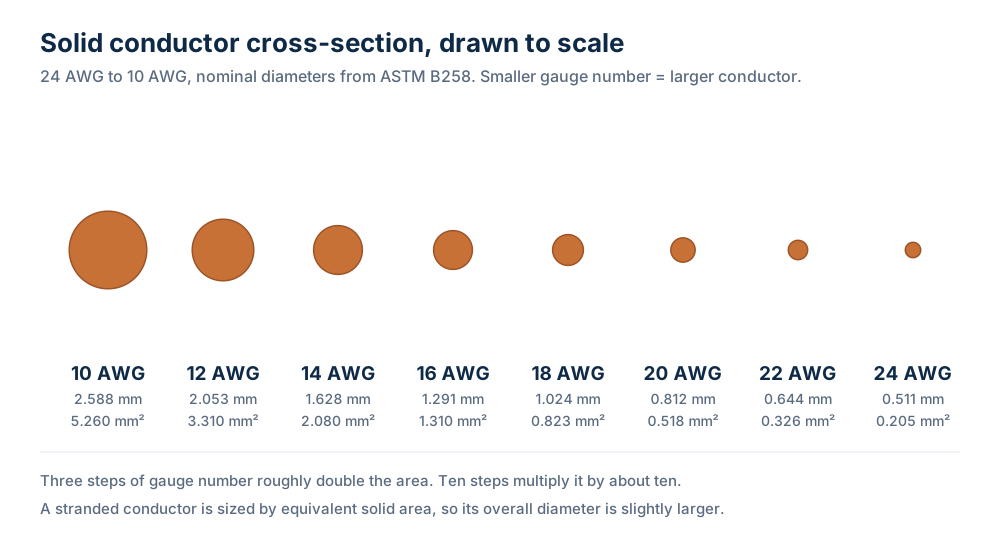
AWG against mm²: the conversion that decides a quotation
Most of the world specifies conductors by cross-sectional area in square millimetres, under IEC 60228, which lists the preferred metric sizes from 0.5 mm² upward. The two systems do not meet on round numbers, and the mismatch is where specifications drift. 0.75 mm² sits between 19 AWG and 18 AWG, closer to 19. 1.0 mm² is about 17 AWG. 1.5 mm² is between 16 and 15. 2.5 mm² is just under 13. There is no metric size that equals 18 AWG, because 18 AWG is 0.823 mm².
The commercial consequence is asymmetric and easy to miss. A buyer who converts 1.0 mm² to “16 AWG” and orders 16 AWG receives a conductor 31% larger and pays for copper they did not need. A buyer who converts 18 AWG to “1.0 mm²” receives 18% more copper, which is harmless. The dangerous direction is the one that sounds equivalent and is not: ordering “20 AWG” as a substitute for 0.5 mm² gives 4% more copper, but ordering “0.5 mm²” against a 20 AWG drawing when the real requirement was 18 AWG gives 39% less. Once a metric figure has been typed into a purchase order, the drawing's original gauge is no longer visible to the factory, and the factory will build exactly what was written.
| AWG | Diameter (mm) | Area (mm²) | Resistance (mΩ/m, 20 °C) | Ampacity 60 °C | 75 °C | 90 °C |
|---|---|---|---|---|---|---|
| 24 | 0.511 | 0.205 | 84.22 | 2.1 | 3.5 | — |
| 22 | 0.644 | 0.326 | 52.96 | 3 | 7 | — |
| 20 | 0.812 | 0.518 | 33.31 | 5 | 11 | — |
| 18 | 1.024 | 0.823 | 20.95 | 10 | 14 | 16 |
| 16 | 1.291 | 1.31 | 13.17 | 12 | 16 | 18 |
| 14 | 1.628 | 2.08 | 8.286 | 15 | 20 | 25 |
| 12 | 2.053 | 3.31 | 5.211 | 20 | 25 | 30 |
| 10 | 2.588 | 5.26 | 3.277 | 30 | 35 | 40 |
| 8 | 3.264 | 8.37 | 2.061 | 40 | 50 | 55 |
| 6 | 4.115 | 13.3 | 1.296 | 55 | 65 | 75 |
Table 1 — the working range for cords, patch leads and small power cable. Diameter, area and resistance are for a single solid copper conductor at 20 °C; ampacity is for copper with not more than three current-carrying conductors, 30 °C ambient, per NEC Table 310.15(B)(16). A dash means the code table does not give a value.
Conductor class: the half of the specification that gets left off
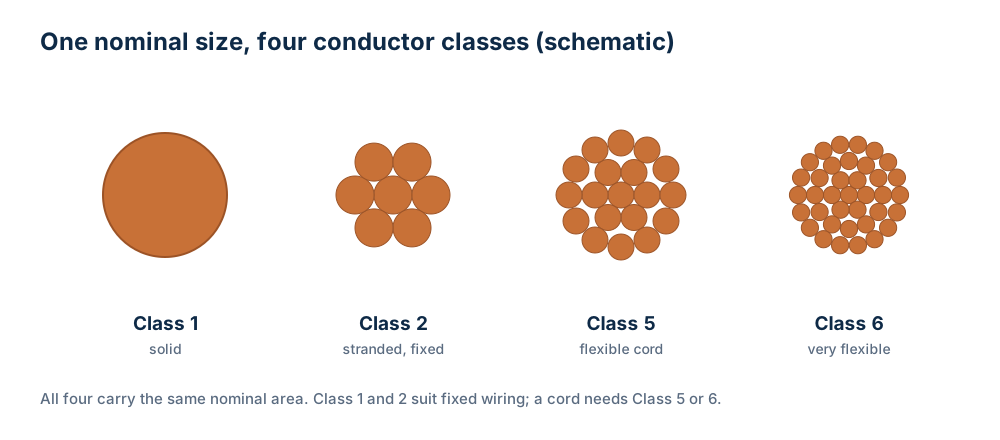
Two cables can both be 1.0 mm² and behave nothing alike. IEC 60228 defines four conductor classes that describe how the metal is arranged rather than how much of it there is. Class 1 is a single solid wire. Class 2 is a stranded conductor intended for fixed installation, with relatively few, relatively thick strands. Class 5 is a flexible conductor, built from many fine strands, and Class 6 is finer again. For Class 2 the standard sets a minimum number of strands; for Class 5 and 6 it sets a maximum diameter for any individual strand, because it is the strand diameter, not the total area, that decides how the conductor survives repeated bending.
The standard is also explicit that nominal size is defined by resistance, not by measuring a diameter. That matters more than it sounds. Two suppliers can both ship a conductor that measures 1.0 mm² and one can fail the resistance limit, because the copper was annealed differently, or because the strands were drawn at the bottom of tolerance, or because the metal is not what the invoice says. Class 5 limits for bare copper are 39.0 Ω/km at 0.5 mm², 26.0 Ω/km at 0.75 mm², 19.5 Ω/km at 1.0 mm², 13.3 Ω/km at 1.5 mm² and 7.98 Ω/km at 2.5 mm². Those five numbers, not the cross-section, are what a test house measures.
The class is written into the cable designation that appears on the jacket of every European cord. Take H05VV-F, the ordinary PVC appliance cord. H means a harmonised standard; 05 means the 300/500 V rating band; the first V is PVC insulation; the second V is a PVC sheath; the dash introduces the conductor; and F means fine wire, Class 5. Change the F to U and the same cable has a solid conductor, and can no longer be sold as a flexible cord. Its rated conductor temperature is 70 °C in flexible use, its test voltage 2,500 V for five minutes, and its minimum bending radius about 7.5 times the cable diameter — numbers that belong in a specification alongside the gauge, and that no gauge figure implies.
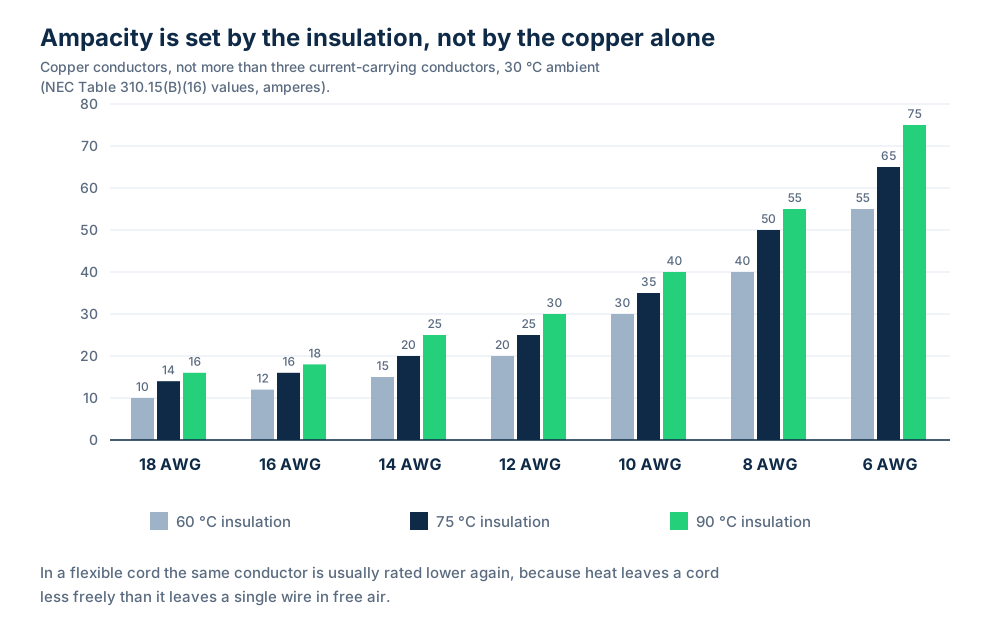
Ampacity: why the same 18 AWG is 10 A in one cable and 16 A in another
Ampacity is the current a conductor can carry continuously without exceeding its temperature rating. Everything about that sentence is about heat leaving, which is why the number attached to a gauge is conditional. The same 18 AWG copper appears twice in Table 1 with different figures depending on whether the insulation is rated 60, 75 or 90 °C, and both figures assume the conductor is in a cable with no more than three current-carrying conductors at 30 °C ambient. Change the ambient, add conductors, tighten the installation, and the number falls again.
Flexible cord has its own rating basis, and it is generally lower than the fixed-wiring figure because a cord dissipates heat less freely than a single wire in free air. A North American 18 AWG three-conductor SJT cord is commonly rated 10 A, which is the same figure the fixed table gives for a 60 °C insulation but well below the 16 A that the 90 °C column shows for the same copper. That gap is not a disagreement between standards; it is the same physics under different assumptions about how the heat escapes. A buyer who quotes “18 AWG, 16 A” from the last column of a table and hands it to a cord factory is quoting an installation condition the cord will never see.
The practical rule is to specify the application, not just the conductor: the product family (cord, patch lead, building wire), the insulation temperature rating, the number of current-carrying conductors, the ambient, and the installation method. A factory can build to any of those; it cannot guess which one was meant.
| What moves the number | Direction | What a buyer should write |
|---|---|---|
| Insulation temperature rating | 70 °C PVC to 90 °C cross-linked compound raises allowable current on the same copper | The material and its temperature class, not just “PVC” |
| Ambient temperature | Rated figures assume 30 °C; a hotter ambient reduces them | Maximum ambient at the installation, in writing |
| Number of current-carrying conductors | More than three bundled together reduce the rating for each | Core count, and whether all cores carry load |
| Installation method | Free air is the most favourable; conduit, insulation and enclosure are less so | Cord, cable tray, conduit or buried |
| Conductor material | Aluminium conducts at about 61% of copper, so the same gauge carries less | “Bare copper” or “tinned copper” stated explicitly |
| Conductor class | Fine strands raise resistance slightly for the same nominal area and change heat paths | Class 5 or Class 6 per IEC 60228 |
Table 2 — six variables that move ampacity on a fixed gauge. Every one of them is a line on the order; none of them is implied by “18 AWG”.
Voltage drop: the constraint that overrides ampacity on long runs
Ampacity asks whether the conductor will overheat. Voltage drop asks whether the appliance will still work. They are different questions with different answers, and on runs beyond about twenty metres the second one usually decides the gauge. The arithmetic is short: for a single-phase circuit, drop in volts equals twice the current times the resistance per metre times the length, the factor of two accounting for the return leg. Convert to a percentage of nominal voltage and compare against the limit the destination market enforces.
Take a 10 m cord at 6 A. In 0.75 mm² Class 5 copper the maximum resistance is 26.0 Ω/km, so the loop is 20 m at 0.026 Ω/m, or 0.52 Ω; at 6 A the drop is 3.12 V, which is 1.36% of 230 V. In 0.5 mm² the same calculation gives 4.68 V, or 2.03%. At 10 A the 0.5 mm² version reaches 3.4%, which is where European practice draws the line: BS 7671 Appendix 4 sets a maximum voltage drop of 3% for lighting and 5% for other uses on installations supplied directly from a public low-voltage system, with larger allowances for private supplies. A cord that carries the current without overheating can still fail the installation because the appliance at the far end sees too little voltage.
Two practical notes save arguments later. First, the resistance figures in Table 1 and in the class limits are maxima at 20 °C; copper resistance rises with temperature, so a conductor running near its insulation limit has more drop than the cold calculation suggests. Second, a longer cord is not simply a cost problem: it is a different electrical product, and the gauge that was correct at 1.8 m may be wrong at 5 m. Export orders for 5 m and 10 m appliance cords are where this issue most often surfaces, after the artwork and the plug tooling are already paid for.
Copper, CCA and the substitution you cannot see
Copper-clad aluminium, CCA, is an aluminium core with a copper skin welded around it. It is a legitimate product with legitimate uses in high-frequency work, where skin effect keeps the current in the copper layer. It is not a legitimate substitute in a power cord or a data cable, and the reason is arithmetic rather than opinion. Aluminium conducts at about 61% of copper, so at the same gauge a CCA conductor has roughly 1.6 times the resistance. Run the Class 5 limit for 0.75 mm² through that ratio and a CCA conductor of the same nominal area lands near 43 Ω/km against a permitted 26.0 Ω/km. It is not a marginal fail; it is a different product.
The compliance position is equally blunt. Category cables are specified with copper conductors: ANSI/TIA-568.2-D requires copper, and UL 444 fire-rated listings for CM, CMR and CMP constructions require copper conductors, which is why a CCA data cable cannot carry a valid listing and an installation using one can be non-compliant even where the cable performs adequately in a short bench test. On the power side, a CCA cord cannot meet a Class 5 resistance limit at the nominal size, so it either fails the test or is upsized — and an upsized CCA conductor no longer fits the terminal, the strain relief or the connector shell designed for the copper version.
Detection is cheap and does not need a laboratory. Weigh a measured length: aluminium is about 30% of the density of copper, so a CCA conductor of the same gauge is visibly lighter. Cut and look at the strand ends under a magnifier: a CCA strand shows a silver core with a copper skin. Measure resistance on a known length with a four-wire method, or send one metre to a test house and compare against the Class 5 table. Any of these three checks, done once per supplier, settles the question for every future order.
The naming trap: five phrases that sound like a specification
“Gauge” is a word that carries a number and therefore feels precise, which is exactly what makes it dangerous. The phrases below appear on real specification sheets and purchase orders, and each one can legitimately be read in more than one way. None of them is wrong in the sense of being false; all of them are incomplete in the sense that two factories will build two different products from them.
| What the buyer writes | What it can legitimately mean | What breaks if it is read the other way |
|---|---|---|
| “16 AWG” | 1.31 mm² solid-equivalent copper, or a 1.0 mm² conductor “rounded” to the nearest gauge | 24% less copper than specified, with no visible difference in the finished cord |
| “1.0 mm²” | Class 5 copper, or Class 2 stranded, or CCA at the same nominal area | A cord that fails flexing, or fails the resistance limit, or both |
| “Heavy duty” | Thicker jacket, or thicker conductor, or a 105 °C compound, or nothing measurable at all | A quotation that looks cheaper because the comparison was never on the same product |
| “18 AWG” measured on the bundle | The outside diameter of a stranded bundle, which reads about 13% larger than the equivalent solid gauge | A conductor one to two gauges smaller than intended, accepted at goods-in |
| “41/0.16” | 41 strands of 0.16 mm, which is 0.82 mm² and about 18 AWG, or a claimed area with a different strand count | A cable described as 1.0 mm² that is 18% short, because the count and the area were never reconciled |
| “Same as last time” | The same drawing, the same supplier, or the same photograph | A silent change of strand construction between lots, discovered in the field rather than at goods-in |
Table 3 — six phrases from real orders. Every row has a documentary answer: a gauge plus a class plus a material plus a tolerance. None of them has a conversational answer.
Five errors, and what each one actually costs
1. Converting a gauge to a metric size and keeping the number. The rounded conversion goes into the purchase order and the original drawing is filed. Cost: 20% to 40% of the copper in the product, invisible in the sample and measurable only by test.
2. Specifying area without class. A 1.0 mm² conductor is ordered, a Class 2 stranded version arrives because it is cheaper, and the cord is used on a product with a moving lid. Cost: strand fatigue at the strain relief, field returns in months, and a failure mode no electrical test will find before it happens.
3. Reading ampacity off the wrong column. 16 A is taken from a 90 °C fixed-wiring table and applied to a 70 °C PVC cord. Cost: the cord runs at its insulation limit, the jacket hardens, and the product fails a temperature-rise test it would otherwise have passed.
4. Ignoring voltage drop on a long cord. The gauge is chosen for current, then the length is changed from 1.8 m to 5 m without recalculating. Cost: an appliance that browns out under load, and a complaint that names the cable even when the appliance is at fault.
5. Accepting CCA without asking. The sample passes a continuity check, the price is attractive, and the resistance limit is never measured. Cost: a non-compliant installation, a listing that cannot be issued, and insurance exposure on top of the scrap value.
What to put on the purchase order
The list below replaces every conversational phrase in Table 3. It is deliberately short: ten lines, of which four do the real work and the other six prevent a silent substitution inside the same shipment.
| # | Field | Usable value | Why it earns its line |
|---|---|---|---|
| 1 | Conductor size, with units | 1.0 mm² (or 18 AWG), stated once and never converted | Removes the rounding error that Table 3 describes |
| 2 | Conductor class | Class 5 to IEC 60228 | Decides flex life; not implied by the area |
| 3 | Conductor material | Bare copper, 99.9% minimum | Excludes CCA and copper-clad steel by name |
| 4 | Construction and cable type | H05VV-F 3G1.0, or SJT 18/3 | Ties gauge to a designation a test house can verify |
| 5 | Core count and earth | 3 cores, one green/yellow | Stops a 2-core cord on a Class I appliance |
| 6 | Insulation temperature class | 70 °C PVC, or 90 °C cross-linked | Sets the ampacity column that applies |
| 7 | Maximum resistance | 19.5 Ω/km maximum at 20 °C | The one number a laboratory can hold a supplier to |
| 8 | Length and tolerance | 1.8 m, plug face to connector face, ±20 mm | Ends the overall-length argument at goods-in |
| 9 | Marking on the jacket | Type, size, approval mark, manufacturer, meter marking | Makes traceability inspectable rather than asserted |
| 10 | Test evidence per batch | Conductor resistance, high-voltage withstand, 100% ageing test | Converts a compliance claim into a document |
Table 4 — ten lines that replace “16 AWG, good quality”. Fields 1, 2, 3 and 7 do the work; the rest prevent a substitution in the same container.
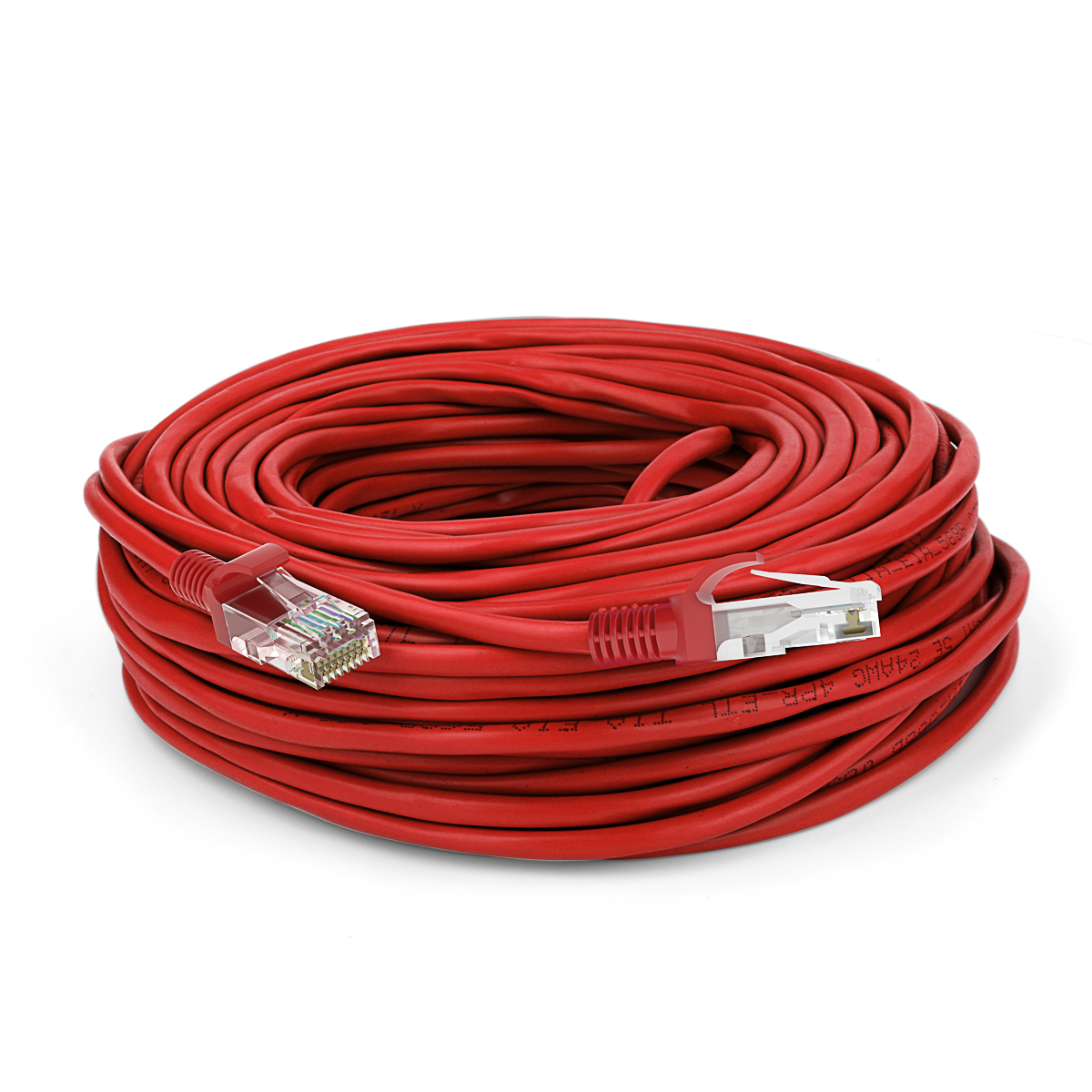
The same discipline applies outside power cords. A network cable order needs the category, the conductor gauge and the conductor material together, because a Cat 6 claim on 24 AWG CCA is neither a Cat 6 cable nor a legal one. A USB cable order needs the gauge of the power pair separated from the gauge of the data pair, since those two decisions are made for different reasons and costed separately. And an HDMI cable order needs the length band alongside the gauge, because conductor size and equalisation are traded against each other once the run passes a few metres.
Three checks anyone can run at goods-in
Inspection does not need a laboratory to catch the common failures. The first check is dimensional: strip 30 mm, count the strands, and measure one strand with a micrometer. Multiply the count by the strand area and compare with the nominal figure on the order — a 1.0 mm² Class 5 conductor built from 0.16 mm strands needs 50 of them, and 32 of them is a different product. The second is mass: cut exactly one metre of each core, weigh it, and compare across lots. Copper is 8.96 g/cm³ and aluminium 2.70 g/cm³, so the difference between copper and CCA on the same gauge is unmistakable on a kitchen scale. The third is electrical: measure the loop resistance of a known length and divide by the length, then compare with the Class 5 limit for that size. A pass on all three is a stronger statement about a shipment than any certificate photograph.
Finish with the jacket. The print should carry the cable type, the size, the approval mark and the manufacturer, and it should be legible and continuous. A cord with no print, or with a print that changes between reels, tells you what the documentation will look like when a customer asks for traceability two years later.
FAQ
Is a lower AWG always better? No. A lower gauge means more copper, which means more current capacity, more weight, more stiffness and more cost. In a patch lead or a thin appliance cord, oversizing the conductor makes the cable harder to route, puts more load on the connector, and can push the assembly outside the bend radius the design allowed. The correct gauge is the smallest one that satisfies ampacity and voltage drop for the application, with margin for the installation.
Can I just convert AWG to mm² and order the metric size? You can convert, but you cannot round down. 18 AWG is 0.823 mm², so ordering “0.75 mm²” because it is the nearest standard metric size removes about 9% of the copper; ordering 0.5 mm² as a “20 AWG equivalent” removes 3%, but ordering 0.5 mm² where the drawing meant 18 AWG removes 39%. If a conversion is unavoidable, step up to the next metric size and record the reason on the drawing.
Why does my 1.0 mm² cord feel thinner than my 18 AWG one? Because it is. 1.0 mm² is about 17 AWG, and 18 AWG is 0.823 mm² — so a genuine 18 AWG conductor has roughly 18% less copper than a 1.0 mm² one. If the thinner cord is the one marked 18 AWG, the marking and the metal disagree, and a strand count will show which is wrong.
Does a higher strand count mean a better cable? It means a more flexible one, up to a point. Class 5 and Class 6 differ in maximum strand diameter because finer strands survive more bending cycles; that is a real benefit in a cord that moves. For fixed wiring, finer stranding adds cost and resistance without adding life. A seller quoting a very high strand count for a static installation is selling flexibility nobody needs.
Is CCA ever acceptable? In RF and high-frequency work, where skin effect keeps current in the copper layer, it has a legitimate place, and it is used in some coaxial and antenna applications. In mains cords and in category data cables it is not acceptable: it cannot meet the Class 5 resistance limits at the nominal size, and it cannot support a UL 444 fire-rated listing, because those listings require copper conductors.
Conclusion
Gauge is the cheapest line on a cable drawing and the one that decides everything downstream. It is a diameter scale, defined for solid round nonferrous wire, and it becomes useful only when it is combined with three other facts: the conductor class that says how the metal is arranged, the material that says what the metal is, and the insulation temperature that says how hot the assembly may run. Add the circuit length and you have the whole electrical argument. Leave any one of them out and the number on the order still looks precise, which is the problem. We build power cords, network cable, USB cable and HDMI cable to a stated gauge, class and material as separate part numbers, with conductor resistance and high-voltage withstand recorded per batch — which is what makes a gauge figure enforceable instead of decorative.
Sources
ASTM B258, Standard Specification for Standard Nominal Diameters and Cross-Sectional Areas of AWG Sizes of Solid Round Wires Used as Electrical Conductors, as summarised in Wikipedia, American wire gauge (retrieved 2026-11): the 36 AWG = 0.127 mm and 4/0 = 0.46 inch anchors, the 39th-root-of-92 ratio (1.1229), the formula d = 0.127 × 92(36−n)/39, the rules of thumb for area, diameter and resistance, the note that stranded wire has about 25% void and roughly 13% larger overall diameter, and the table of diameters, areas, resistance and 60/75/90 °C ampacity taken from NEC Table 310.15(B)(16) (formerly 310.16) with the 30 °C ambient and three-conductor conditions stated. IEC 60228:2004, Conductors of insulated cables, as summarised in Wikipedia and in a cable manufacturer's standard note (retrieved 2026-11): classes 1, 2, 5 and 6, the preferred metric sizes from 0.5 mm², the requirement that nominal size be defined by resistance, and the distinction between minimum strand count for Class 2 and maximum strand diameter for Classes 5 and 6. Class 5 maximum conductor resistance values (39.0, 26.0, 19.5, 13.3 and 7.98 Ω/km for 0.5, 0.75, 1.0, 1.5 and 2.5 mm²) as published in flexible-cable data tables. H05VV-F technical data (300/500 V, 70 °C in flexible use, 2,500 V five-minute test voltage, 7.5× diameter bending radius, PVC to DIN EN 50525-2-11 and IEC 60227-5) from a published cable datasheet. TME, Designation of cables according to harmonised standards (2020), for the PN-HD 361 S3 letter and digit system (H, 05, V, V, −F) used above. BS 7671 Appendix 4, Table 4Ab, Regulation 6.4, for the 3% lighting and 5% other-use voltage-drop limits. Wikipedia, Copper-clad aluminium wire (retrieved 2026-11), for CCA construction, the 61% conductivity of aluminium relative to copper, the ANSI/TIA-568.2-D copper requirement, and the UL 444 fire-rating requirement that copper conductors be used. 18 AWG three-conductor SJT cord rated 10 A: distributor product data for 18/3 SJT cords. Note: the CCA resistance comparison and the voltage-drop figures in this article are arithmetic derived from the cited resistance and conductivity values, not measurements of a specific shipment; they are indicative and should be replaced by a test report for any contractual purpose.